


More:
News & Stories
The Challenges of the Next AI Generation: Efficiency, Responsibility, and Risk Management
The Efficient & Responsible AI R&D Summit was held at the Intel Haifa campus. The conference brought together experts from academia in Israel and abroad with senior executives from leading technology companies. "This can only be achieved through collaboration between academia and industry," said Prof. Eduard Yakubov, President of HIT, referring to the essential partnership between academia and industry for Israel's future.
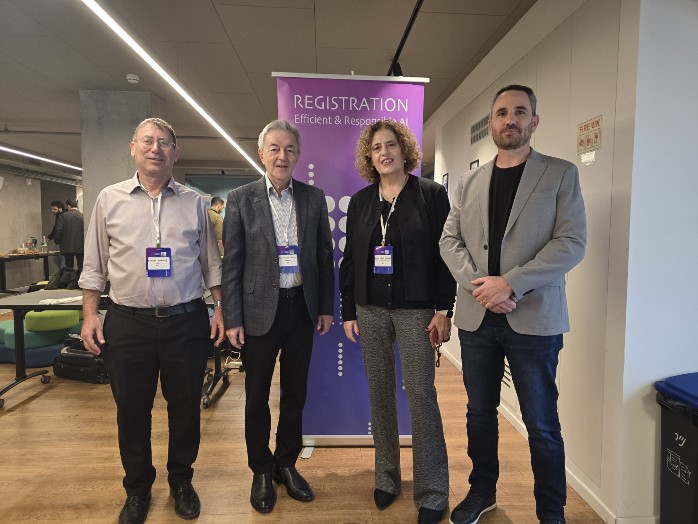
Technology leaders, AI and data science experts, researchers and developers from industry and academia gathered to review innovations in responsible AI and practical applications, while fostering dialogue and cooperation between sectors. The Summit presented case studies, research, and implementation insights in key AI domains shaping the technological landscape.
The conference, led by Intel, HIT, and IAHLT, focused discussions and presentations on the economic and systemic challenges of the next AI generation: large language models, autonomous agents, and advanced computational architectures, particularly addressing how to manage risks when algorithms begin making real-world decisions—alongside considerations of responsibility and efficiency.
Among the conference speakers, HIT President Professor Eduard Yakubov emphasized the importance of closer collaboration with industry and addressed the dangers of accelerated adoption of AI technologies without a clear regulatory framework. "This can only be achieved through collaboration between academia and industry," he said.
The conference was initiated by Dr. Nava Shaked, Head of the School of Multidisciplinary Studies at HIT, and Avner Algom, founder and manager of the AI Academia-Industry community. HIT participants included Dr. Rafael Berkan, Vice President for Innovation, Entrepreneurship, and International Relations, and Dr. Kobi Barda from the School of Multidisciplinary Studies.
The Guests of honor were Dr. Sarah Basson, Head of Accessibility, Disability, and Inclusion at Google Global, and Prof. Constantinos Petrides, Vice Rector for Internationalization at the Mediterranean University of Cyprus.
The conference, which aimed to facilitate productive discussion between academia and industry representatives on ethical, regulatory, and accountability issues, also included senior executives from Intel, Rafael, Bright Data, Dell, the National Digital Authority, and other leaders from prominent organizations who discussed insights, trade-offs, and solutions supporting responsible AI.
Dr. Sarah Basson noted that artificial intelligence does not eliminate human biases. According to her, "Humans build the algorithms, collect the data, and decide what to do with the results." She pointed at visual algorithms that continue to exclude entire populations, sometimes without organizations being aware of it, and stated that part of Google's corporate and social responsibility is to make information accessible to all populations, including in developing countries.
Elad Shtrit, Senior Vice President for Research and Development at “Rafael”, described a conceptual shift in operating combat systems: "We're moving from a world where an operator manually flies a drone to a world of agents—the operator speaks and the system autonomously operates a fleet of drones," he said. According to him, Rafael is already testing AI capabilities on real operational materials, but acknowledges that the central dilemma remains: "How much can we trust the system and let it make decisions independently?"
The infrastructure issue also came up for discussion. Tomer Sasson, Vice President of Intel's Personal Computing Division, challenged the dependence on the cloud and emphasized the importance of Edge computing. "The future of AI will increasingly rely on edge processing—in personal computers, robotics, and vehicle systems." According to him, this is not only about saving costs and energy, but a fundamental condition for reliability and control.
Prof. Petrides spoke in his lecture about the integration of artificial intelligence in academia and said that international collaborations are one of the answers to the challenges posed by the AI era, emphasizing the clear need for regulation along with creative thinking to leverage the significant advantages and efficiency that AI brings for the benefit of the entire world.
At the conference's conclusion, participants agreed that as AI systems penetrate more critical areas of life—from medical decision-making to employee recruitment and financial credit—the need for clear principles ensuring transparency, fairness, and accountability grows. Leading organizations now understand that AI technology not implemented responsibly can cause legal damage, harm to reputation, and loss of public trust. Academia, for its part, plays a vital role in developing methodologies for bias assessment, creating ethical standards, and training a new generation of AI developers aware of the societal implications of their work. The integration of academic research with practical implementation in organizations is the key to creating AI systems that are not only efficient, but also fair and trustworthy.
 Additional programs

- News & Events

International Week of Interdisciplinary Studies and Academic Collaborations in Crete
A substantial delegation of 16 students and four faculty members from HIT Holon Institute of Technology participated in week-long international activities and events at HMU-Hellenic Mediterranean University in Crete. ...